
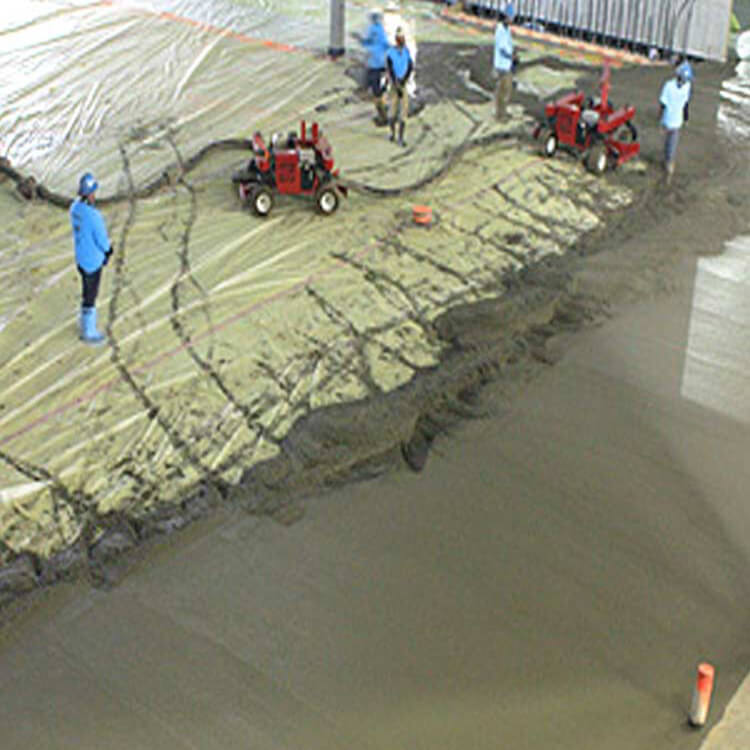
Various methods are employed to mitigate the shrinkage effect in concrete, including shrinkage compensating concrete. This approach focuses on expanding the concrete rather than allowing it to contract. This method produces concrete by forming either Ettringite (type K, calcium Sulfoaluminate, or compounds based on calcium aluminate) or calcium hydroxide (lime-based compounds). It is crucial to exercise caution when employing this method to prevent rapid setting, reduced workability, and, most importantly, uncontrolled expansion. Another technique involves using anti-shrinkage additives, which were first introduced in Japan in 1985 and later entered the North American market in 1995. These additives chemically modify the shrinkage mechanism without causing expansion.
Several factors influence concrete shrinkage, including:
- Water-to-cement ratio
- Cement content and type of aggregates
- Type of cement
- Concrete mixing plan
- Surface-to-volume ratio
- Relative humidity and other environmental conditions surrounding the concrete
Shrinkage in concrete and mortar can occur in three states:
The plastic phase is spontaneous and during drying. Plastic shrinkage transpires when the rate of water evaporation from the fresh concrete surface exceeds the rate of bleeding. This type of shrinkage predominantly occurs before the final set due to the rapid evaporation of water from the exposed concrete surface. Elevated concrete temperature, high wind speed, and low humidity expedite water evaporation. The rate of bleeding is also influenced by factors such as concrete constituents, mixing proportions, desired element thickness, compaction type, and concrete surface finish. Plastic shrinkage typically results in parallel, shallow cracks known as craze, ranging in depth from 25 to 50 mm. However, when drying shrinkage exacerbates the conditions in addition to plastic shrinkage, the cracks can penetrate deeper. Thin concrete elements such as slabs, pavements, bridge decks, industrial floors, tunnel linings, and repaired surfaces with a high surface-to-volume ratio are particularly susceptible to these cracks. High-strength concretes featuring low water-cement ratios, and pozzolanic materials (e.g., overburden, fly ash, and silica fume) are more prone to plastic shrinkage cracks. This shrinkage predominantly occurs within the first seven days after concrete molding.
Spontaneous shrinkage transpires while the concrete is still in a liquid state. It occurs due to changes in the pore structure and size of the concrete, resulting in reduced porosity and pore size. This type of shrinkage is closely related to cement hydration, as the chemical reactions occurring during hydration are the driving force behind it. As hydration progresses, the absolute volume decreases due to the reaction between water and cement materials and the subsequent change in density of the reaction products compared to the reactive materials. The volume reduction stems from the fact that the density of the reaction products is lower than that of the original materials, resulting in spontaneous shrinkage.
Drying shrinkage occurs in dry climates when there is a difference in relative humidity between the concrete and the surrounding air. In essence, this phenomenon is linked to the evaporation of water from the hydrated cement. When saturated cement is exposed to an environment with lower moisture content, it loses moisture from its larger pores, leading to shrinkage. After the concrete has fully set, drying shrinkage occurs due to the evaporation of water from the concrete’s pores, causing a decrease in volume. In high-strength concrete with low water content, drying, and spontaneous shrinkage pose significant risks as they increase the likelihood of severe cracking. In concretes with normal strength (28-day strength less than 34 MPa), drying shrinkage outweighs the significance of spontaneous shrinkage. It’s important to note that shrinkage alone does not cause cracking in concrete. Cracking is dependent on whether the concrete is restrained or not. External or internal restraints resulting from the contraction of restrained concrete induce stress, leading to cracks in the concrete member. Since most concrete structures are restrained by the ground, foundation, reinforcement, or other structural members, tensile stresses arise. If the magnitude of these stresses exceeds the tensile strength of the concrete, cracks develop within the structure.


Reviews
There are no reviews yet.